Solar calculator
Set how many of each appliance you run and for how many hours a day.
| Appliance | Watts | How many | Hours/day |
|---|---|---|---|
| LED bulbs | |||
| TV (32-inch LED) | |||
| Fridge (average draw) | |||
| Phone charging | |||
| Laptop | |||
| WiFi router | |||
| Water pump (0.75kW) | |||
| Iron box |
Daily use
0.6 kWh
Panels
200 W
Battery
20Ah
at 24V, about 0.3 kWh
Inverter
0.5 kVA
A rough first estimate: panels allow about 25% losses; the inverter allows 30% headroom over everything running at once. Motors such as pumps and fridges start with a surge that a good installer will size for.
The four numbers that size a solar system
Every solar sizing calculator works through the same four steps:
- Daily energy (kWh): how much electricity your appliances use in a day.
- Panel watts: how much panel you need to make that energy in the sun hours where you live.
- Battery size (Ah): how much energy you need to store for the night or for cloudy days.
- Inverter size (W or kVA): the most power your appliances draw at the same moment.
Get the first number right and the rest follow. Most badly sized systems in Kenya fail because the owner guessed the daily load or forgot one big appliance.
Solar calculations: the formulas
Daily energy. For each appliance: watts × hours used a day = watt-hours (Wh). Add them up. Divide by 1,000 for kWh. The watts are on the appliance label; for a fridge, use the daily kWh on its energy label if it has one, because the compressor cycles on and off.
Panel watts. Daily Wh ÷ (peak sun hours × 0.7). The 0.7 allows for heat, dust, cable losses and charging and inverter losses. In hot, dusty places some installers use 0.65.
Battery size. Night-time Wh ÷ (battery voltage × usable depth of discharge × 0.9). Use about 0.8 depth of discharge for lithium (LiFePO4) and about 0.5 for lead-acid or gel, which wear out fast if drained further. The 0.9 covers inverter losses. Multiply by the number of days of backup you want for cloudy weather.
Inverter size. Add the watts of everything that could run at the same time, then add about 25%. Check that the inverter's surge rating covers motors such as fridges and pumps, which can draw several times their running power for a moment when they start. Many inverters rated in kVA give less in watts, so read the watt rating.
Charge controller. Panel watts ÷ battery voltage × 1.25 = controller amps. Many hybrid inverters have one built in.
A worked example (hypothetical home)
This is an example to show the method, not a real customer. The appliances are typical round figures.
- 6 LED bulbs, 10W each, 5 hours a day: 300 Wh
- TV, 60W, 4 hours: 240 Wh
- Fridge, about 1 kWh a day from its label: 1,000 Wh
- Laptop, 60W, 4 hours: 240 Wh
- Wi-Fi router, 10W, 24 hours: 240 Wh
- 4 phones, 10W each, 2 hours: 80 Wh
Daily energy: 2,100 Wh, or 2.1 kWh.
Panels: with 5 peak sun hours, 2,100 ÷ (5 × 0.7) = 600W. Two 300W panels, or a single larger panel plus some margin, would cover it.
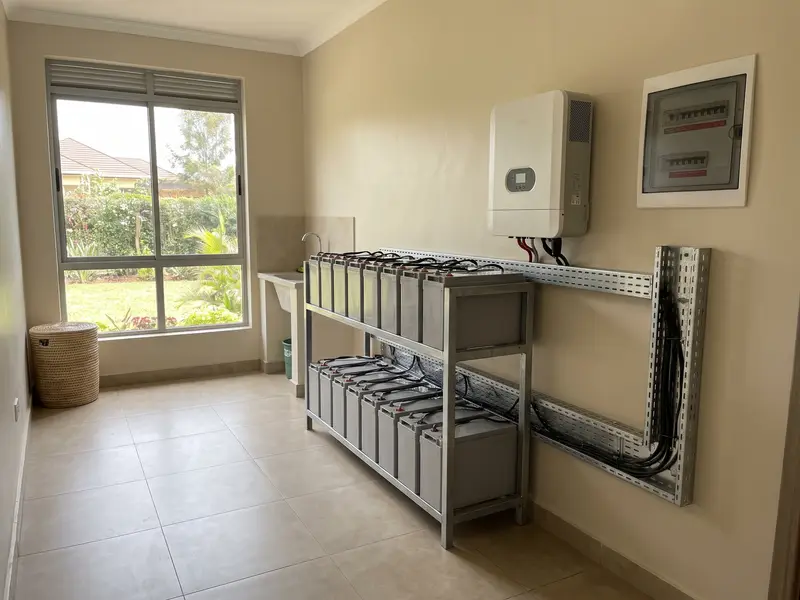
Battery: at night this home uses about 1,240 Wh (lights, TV, phones, half the fridge and half the router). On a 24V lithium bank: 1,240 ÷ (24 × 0.8 × 0.9) = about 72Ah, so a 24V 100Ah lithium battery gives one night with margin. On lead-acid: 1,240 ÷ (24 × 0.5 × 0.9) = about 115Ah, so 24V 150Ah.
Inverter: everything on at once is about 330W running, plus 25% is about 410W. The fridge's starting surge pushes this up, so a 1kVA inverter is a comfortable choice.
Charge controller: 600 ÷ 24 × 1.25 = about 31A, so a 40A MPPT controller.
See what systems of this size cost on our solar system prices page.
Sun hours in Kenya
A peak sun hour is one hour of sunlight at full strength (1,000 watts per square metre). A day with 5 peak sun hours gives the same energy as 5 hours of full sun, even though the sun is up for 12.
Most of Kenya gets roughly 4–6 peak sun hours a day, with less in cloudy and rainy months and in the highlands during the long rains. Check your location before you size: free tools such as the European Commission's PVGIS or NASA's POWER data show the figure for any point on the map.
If you are unsure, size with 4.5 hours rather than 6. A system sized for a good day will run short in a cloudy week.
Solar PV sizing worksheet
Copy this worksheet onto paper or a spreadsheet and fill it in for your home or business.
- List every appliance. Name, watts, hours a day, Wh a day (watts × hours). Mark the ones you need at night.
- Total daily Wh. Add the Wh column.
- Night-time Wh. Add the Wh for night use only.
- Peak sun hours for your area (use 4.5 if unsure).
- Panel watts = line 2 ÷ (line 4 × 0.7).
- Battery voltage: 12V for small systems, 24V for most homes, 48V for large homes and businesses.
- Battery Ah = line 3 ÷ (line 6 × depth of discharge × 0.9) × days of backup.
- Peak load: watts of everything that could run at the same time, plus 25%.
- Inverter: at least line 8, with a surge rating that covers any motor.
- Charge controller amps = line 5 ÷ line 6 × 1.25.
Take the finished worksheet to installers. It makes quotes easier to compare, because everyone is pricing the same load. Our guide to solar panel sizes helps you turn panel watts into real panels, and solar batteries explains the battery types.
When to stop calculating and ask an installer
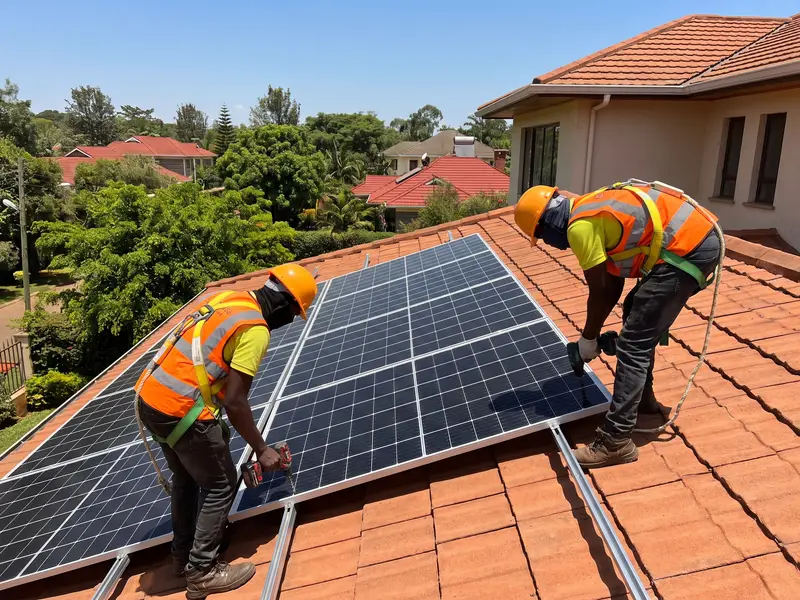
A calculator gives you a fair first estimate. An installer should still visit before you buy, because the real answer depends on things a calculator cannot see: roof direction and shade, cable runs, your existing wiring, and whether you want the system to work alongside KPLC power.
Ask every installer to show their own load calculation. If two quotes for the same worksheet differ a lot in panel or battery size, ask why. Send one request through Get quotes and compare up to 3 licensed installers.