What it costs
| Size / type | Typical price | Range | Listings |
|---|---|---|---|
| 8-12kVA grid-tie | KSh 240,000 | 134,900 – 515,000 | 28 |
| 8-12kVA hybrid | KSh 195,000 | 82,500 – 598,500 | 58 |
| 8-12kVA off-grid/backup | KSh 289,500 | 76,500 – 504,900 | 23 |
| >12kW (commercial) grid-tie | KSh 357,535 | 136,000 – 1,250,000 | 55 |
| >12kW (commercial) hybrid | KSh 507,500 | 119,000 – 1,750,000 | 26 |
| >12kW (commercial) off-grid/backup | KSh 384,268 | 129,000 – 2,495,000 | 8 |
Inverter only. A commercial system's price also depends on panels, batteries, structures and engineering, so it is always quoted per site. Prices from listings on Kenyan shops and marketplaces, checked October 2026. Listings with impossible specs are left out.
What a commercial solar system is
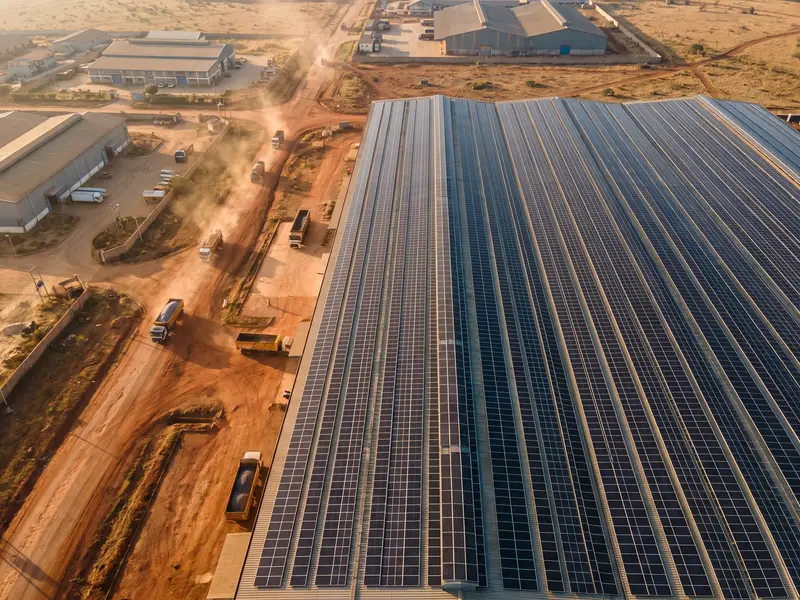
A commercial solar system is a larger solar PV installation built for a business, institution or farm. It is usually from about 10kW upwards, often on three-phase power, and designed around the site's own load profile.
Typical users:
- Offices, shops and malls that use most of their power in daylight.
- Factories and workshops with motors, compressors and cold rooms.
- Hotels, schools and hospitals that need power day and night.
- Farms for irrigation, cooling, dairy and processing. See also solar water pumps.
Because daytime use is high, many businesses start with a grid-tied system and add batteries only for critical loads.
Solar farming and solar farms in Kenya
Solar farming means generating power from large ground-mounted arrays: rows of panels on frames over open land. It ranges from a few hundred kilowatts that power one factory or farm to utility-scale solar farms that sell power into the national grid.
Utility-scale plants are a separate world of power purchase agreements and large developers; our page on solar power plants in Kenya covers them. On this site, the useful end is private solar farming: a business or farm using its own land to power its own operations. That works well where there is spare land, high daytime use and a weak or costly grid supply.
What drives the cost of commercial solar
Commercial systems are always priced per site. The main cost drivers are:
- System size in kW, set by your daytime load and roof or land area.
- Batteries or not. A grid-tied system is far cheaper than one that must carry the site through outages.
- Inverter brand and type. Commercial inverters above 12kW typically cost about KSh 357,500 (grid-tie) to KSh 507,500 (hybrid) on their own in the listings we checked.
- Structure. Roof strength, ground-mount frames, carports and fencing.
- Distance and cabling from the array to the main board.
- Engineering, monitoring and maintenance agreements.
For homes and small businesses, our solar system prices page gives typical prices up to 10kVA.
Grid-tied, hybrid or backup for a business
- Grid-tied gives the most kWh for the money and suits daytime users. It does not run during KPLC outages.
- Hybrid adds batteries so key loads keep running through outages. It costs more, so many businesses put only critical circuits (servers, tills, cold rooms, security) on the battery.
- Solar plus generator suits sites with long outages or no grid, using solar to cut fuel use.
A good commercial contractor will model each option against your bills and outage history. Large grounds, estates and car parks often add solar street lights as a separate, simpler project.
How a commercial solar project runs
- Energy audit. The contractor studies your bills and, ideally, logs your load over days or weeks.
- Site survey. Roof condition and strength, shading, space for inverters and batteries, and the main distribution board.
- Design and proposal. System size, layout, expected yield and an itemised price.
- Installation and commissioning. Mounting, wiring, protection, testing and handover.
- Monitoring and maintenance. Panel cleaning, inverter checks and a plan for faults.
Ask for the expected yearly output in kWh, not just the kW size, so you can compare offers on what they will save you. Our solar installation guide covers what good workmanship looks like.
Starting a solar business in Kenya
If you want to sell or install solar rather than buy it, EPRA licences set out who can do what:
- C1 (contractor): design and installation of solar PV systems. Must be, or employ, a T3 technician.
- V1 (vendor): design, distribute, promote, sell or install solar PV systems. Needs a T2 technician.
- V2 (manufacturer or importer): manufacture or import solar PV systems or components. Needs a T2 technician.
EPRA's documents give application, grant and annual renewal fees of KSh 500, 1,000 and 1,000 for C1, and KSh 1,000, 2,500 and 1,000 for V1. A solar factory or import business would need the V2 class. See EPRA solar licence for the technician classes, and for installers to list your company here.