What it costs
| Size / type | Typical price | Range | Listings |
|---|---|---|---|
| 1kVA hybrid | KSh 19,799 | 15,490 – 33,000 | 31 |
| <1kVA (DC-AC/small) hybrid | KSh 18,500 | 12,900 – 18,720 | 7 |
| 1.5kVA hybrid | KSh 24,500 | 19,000 – 35,000 | 22 |
| 2kVA hybrid | KSh 34,000 | 19,999 – 90,000 | 25 |
| 3kVA hybrid | KSh 52,750 | 25,000 – 199,500 | 72 |
| 4kVA hybrid | KSh 47,110 | 38,940 – 69,000 | 6 |
| 5-6kVA hybrid | KSh 90,328 | 36,500 – 450,000 | 90 |
| 8-12kVA hybrid | KSh 195,000 | 82,500 – 598,500 | 58 |
| >12kW (commercial) hybrid | KSh 507,500 | 119,000 – 1,750,000 | 26 |
Typical prices from the listings we checked. Off-grid and grid-tie prices are on our inverter prices page. Prices from listings on Kenyan shops and marketplaces, checked October 2026. Listings with impossible specs are left out.
What a solar inverter does
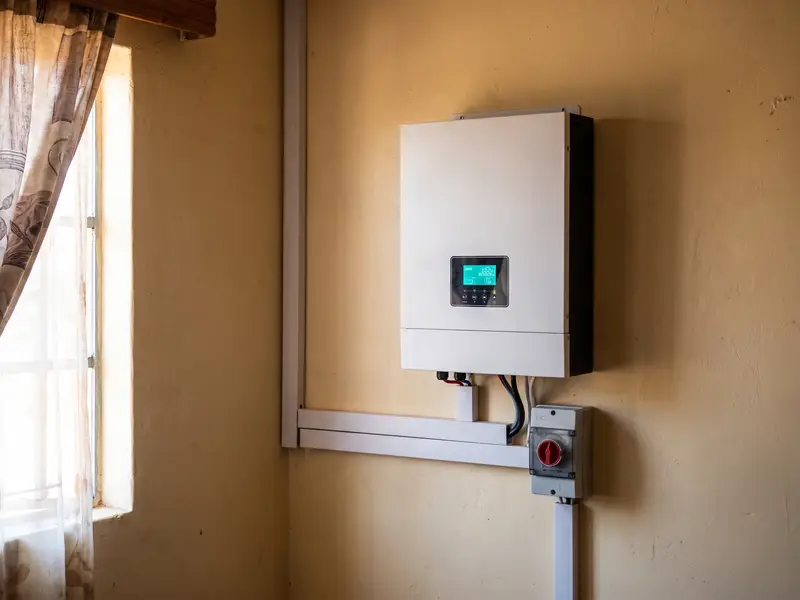
Solar panels and batteries produce direct current (DC). Your TV, fridge and sockets use alternating current (AC) at about 240V. The inverter is the converter between the two. In most home systems it also does more:
- charges the batteries from the panels (a built-in solar charge controller);
- charges the batteries from KPLC when the sun is weak;
- switches your house to battery power when the grid goes off;
- shows how much power you make and use.
Because everything passes through it, the inverter decides how much you can run at once. Get it wrong and the system trips every time the kettle goes on.
Solar PV inverter types
- Off-grid solar inverter. Runs from batteries and panels with no grid. Some are simple DC to AC converters with no solar charging; others include a charge controller. For homes and farms beyond the KPLC line.
- Hybrid inverter. Panels, batteries and KPLC all connect to one unit, which picks the best source automatically. The most common choice for Kenyan homes and small businesses today. See hybrid solar inverters.
- Grid-tie inverter. Feeds solar power straight into your building's supply with no battery. Cuts the daytime bill, but switches off in a blackout. Mostly used on commercial roofs.
- Solar 3 phase inverter. For buildings with a three-phase supply and heavy motors, such as workshops, schools and farms. Available as hybrid or grid-tie.
- Backup inverter (UPS). Charges batteries from KPLC only. Some can take solar later through a separate charge controller.
How to size an inverter
Inverters are sold in kVA (roughly kW for home use). Size yours like this:
- Add up what runs at the same time. Lights, TV, fridge, router and a laptop might total 600W. Add an iron or a kettle and it jumps by 1,000 to 2,000W.
- Allow for start-up surges. Fridges, freezers and pumps draw several times their running power for a moment when they start.
- Add some headroom. An inverter that runs near its limit all day runs hot and wears faster.
As a rough guide, 1kVA to 1.5kVA suits lights, TV and small appliances; 3kVA runs a typical home with a fridge; 5kVA and above handles a larger house, a small borehole pump or a shop. Match the inverter's battery voltage (12V, 24V or 48V) to your solar batteries.
What solar inverters cost
From the listings we checked, a 1kVA hybrid inverter typically sells for about KSh 19,800, a 3kVA hybrid for about KSh 52,800 and a 5 to 6kVA hybrid for about KSh 90,000. Big-name brands sit well above the typical price; marketplace units sit below.
Our solar inverter prices page has the full list, including off-grid and grid-tie units, and solar system prices shows what a complete system costs.
Can you install solar panels and an inverter by yourself?
A small DC kit with one panel and one battery is simple. A system with an inverter, several batteries and a connection to your house wiring is a different job. Under Kenya's solar regulations, systems with multiple batteries and an inverter fall under EPRA's T2 technician class, and grid-connected and hybrid systems under T3. A wrong cable size or a missing breaker can start a fire, and a badly wired hybrid can feed power back into KPLC lines.
A licensed installer will size the DC cables and fuses, set the inverter for your battery type, earth the system and show you how to read it. Check the charge controller basics if your inverter does not include one.