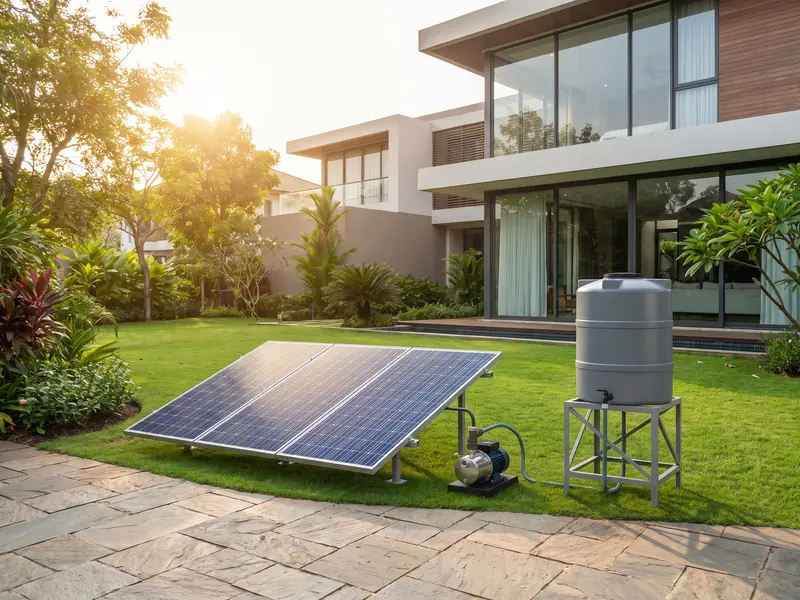
What it costs
| Size / type | Typical price | Range | Listings |
|---|---|---|---|
| DC surface/booster pumps (12-24V) | KSh 22,555 | 4,799 – 99,000 | 13 |
| DC submersible ~250-300W kit (with panel) | KSh 18,999 | 14,724 – 72,300 | 26 |
| DC submersible ~250-300W, pump only | KSh 9,400 | 5,499 – 45,000 | 35 |
| submersible 370-800W | KSh 37,995 | 14,500 – 164,000 | 23 |
| submersible 1-2.2kW | KSh 87,500 | 29,990 – 505,000 | 8 |
| Dayliff solar pumps | KSh 58,000 | 13,590 – 199,800 | 19 |
| Lorentz PS pump systems (pump+controller) | KSh 195,300 | 64,125 – 989,888 | 44 |
| solar pumping inverters (VFD) | KSh 101,750 | 29,900 – 745,000 | 66 |
| submersible (power not stated) | KSh 13,999 | 5,499 – 78,999 | 35 |
Small DC pumps are sold as a pump alone or as a kit with a panel; engineered systems are priced as pump and controller, before panels and installation. Prices from listings on Kenyan shops and marketplaces, checked October 2026. Listings with impossible specs are left out.
Which solar pump do you need?
It comes down to where the water is and how far it has to go.
- Submersible (borehole or deep well) pumps sit down in the water and push it up. Use one when the water is more than about 7 metres below ground. Small 24V DC submersibles of about 250–300W lift water for a household or a few animals; pumps of 370W to 2.2kW and engineered systems like Lorentz serve farms, schools and estates.
- Surface pumps sit above ground and pull water from a shallow well, river, dam or tank. They are cheaper and easier to service, but can only lift water a few metres before it reaches them.
- Booster pumps add pressure to water already in a tank, for showers and taps upstairs.
- Solar pumping inverters (VFDs) let an ordinary AC pump you already own run from solar panels. They are the usual choice for larger pumps above about 1kW.
If you are not sure, a good installer will ask for your borehole depth, the water level, how far and how high the water has to travel, and how much you need each day before recommending anything.
How to size a solar pumping system
Three numbers decide the size of the pump and the panels:
- Daily water need. A household might use a few hundred litres a day; a small farm under drip irrigation can use thousands.
- Total head. The height from the water level to the top of the tank, plus an allowance for the length of pipe. Higher head needs a stronger pump.
- Sun hours. Most of Kenya gets strong sun, but output drops on cloudy days. Pumping into a raised tank stores the day's water for the evening and for cloudy days, which is far cheaper than batteries.
Ask every installer for the pump curve: the flow it gives at your head. Two pumps with the same wattage can deliver very different amounts of water.
What makes the price go up
- Depth and head. Deep boreholes need multi-stage pumps and more panels.
- Flow. Irrigation pumps move far more water than a household pump.
- Brand and controller. Engineered systems with a proper controller cost more but protect the pump from running dry and from voltage swings.
- Extras. Panels and mounting, cable down the borehole, a float switch, the tank and its stand, and pipework are often quoted separately. Ask for a full list.
Our solar water pump price guide breaks the prices down further.
Pay in full or lipa mdogo mdogo
Most installers want payment in full, often with a deposit before the work starts. Some pump brands sell on pay-as-you-go terms, where you pay a deposit and then weekly or monthly instalments. Compare the total you will have paid at the end, not just the deposit. Our page on pay-as-you-go solar explains how these plans work.