What it costs
| Size / type | Typical price | Range |
|---|---|---|
| street <=150W | KSh 13,975 | 1,450 – 66,900 |
| street 200-500W (claimed) | KSh 7,062 | 1,440 – 38,500 |
| street 800W+ (claimed) | KSh 6,988 | 5,240 – 13,750 |
| street lights (W not stated) | KSh 1,399 | 536 – 54,950 |
Light head only, wattages as listed by sellers. They are marketing figures; price follows panel and battery size. Poles, foundations and installation are extra. Prices are approximate and vary by brand and seller.
What solar street lights cost in Kenya
The light head alone typically sells for:
- about KSh 14,000 for lights listed as 150W or less, from about KSh 1,450 to KSh 67,000;
- about KSh 7,000 for lights listed as 200–500W;
- about KSh 7,000 for lights listed as 800W or more, from about KSh 5,200 to KSh 13,750.
The smallest-sounding lights cost the most because they are mostly integrated all-in-one units from specialist solar suppliers, while the big wattages are marketing labels on cheap lights. Lights with no wattage stated were typically about KSh 1,400. These are prices for the lamp unit only. The pole, its concrete foundation, transport and installation add a large share to the cost of each finished light, and suppliers rarely publish prices for them. Ask for an installed price per pole.
Buyer's warning: 800W and 5000W street lights do not exist at these prices
The wattages on most solar street lights sold online are marketing figures, not real LED power. Some street lights are even advertised as 5000W for about KSh 8,000.
A light that really drew 800W for 12 hours would use nearly 10kWh a night. A lithium battery of about 10kWh alone typically sells for about KSh 195,000, before the panels to charge it. A street light at KSh 7,000 is a much smaller light with a much smaller battery.
That is why the table shows lights "listed as 200–500W" costing less than lights listed as 150W. Price follows the real panel and battery, not the claim. When you compare lights, ask for:
- Real lumens of the LED.
- Battery capacity in Wh and type (LiFePO4 lasts longest).
- Panel size in real watts (Wp).
- Autonomy: how many nights the light runs without sun.
- A datasheet from the manufacturer, not just a photo in an online advert.
All-in-one or split street lights
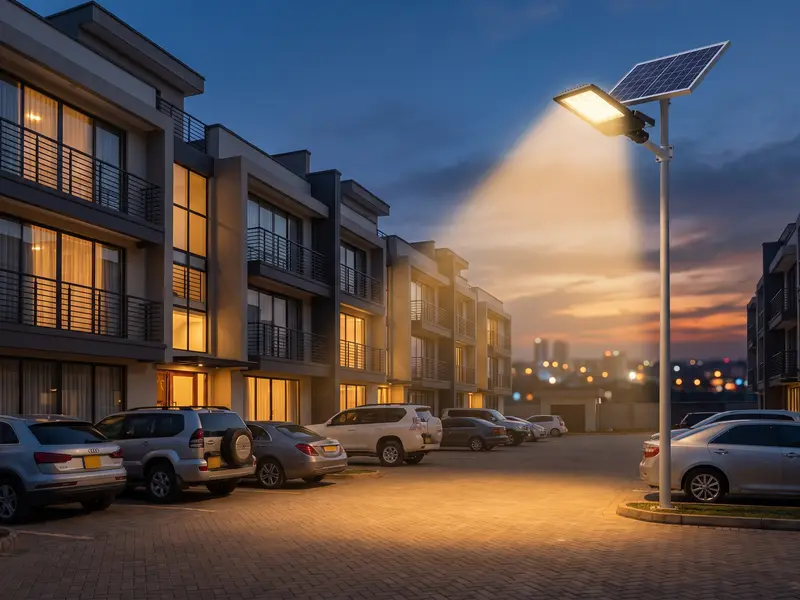
- All-in-one (integrated) lights have the panel, battery and LED in one unit on top of the pole. They are quick to install and common for estates and private roads.
- Split lights have a separate panel and a battery box on the pole, or the battery buried at its base. They can take a bigger panel and battery, so they suit main roads, long nights and places where light must not fail.
For most compounds and estate roads, a good all-in-one light on a 6–8 metre pole is enough. For public roads and markets, a split design with more battery is safer.
Solar powered street lamps for estates, schools and counties
A good street light project starts with a short brief:
- Road length and width, and the gap you want between poles.
- How bright it must be, and for how many hours a night.
- Theft and vandalism risk. Anti-theft bolts, a tall pole and a battery high up or locked away.
- Maintenance. Who will clean panels and replace batteries in five to eight years.
A licensed installer can turn that into a layout and a price per pole. Ask each one to state the real lumens, battery Wh and panel Wp of the light they propose, so you can compare quotes on the same terms rather than on label watts. For larger jobs, see our page on commercial solar.
Solar street lights with CCTV cameras
Some sellers offer street lights with a camera built in, or a camera on the same pole sharing the light's panel and battery. Prices vary a lot between models. A camera adds load to the battery, so the light and camera must be sized together. See solar CCTV cameras for camera-only prices, and ask installers to quote for both.