What it costs
| Size / type | Typical price | Range |
|---|---|---|
| power station <700Wh | KSh 37,000 | 16,899 – 68,000 |
| power station ~1kWh | KSh 38,075 | 26,500 – 106,499 |
| power station 1.5-2kWh+ | KSh 92,250 | 47,500 – 850,000 |
Power station only, without a solar panel unless stated. Capacity is the battery size in watt-hours (Wh). Prices are approximate and vary by brand and seller.
Power station, solar generator or home solar system?
A portable power station stores energy in a lithium battery and gives it back through AC sockets, USB ports and a 12V car socket. There is nothing to install: you charge it, carry it to where you need power and plug in.
A solar generator is the same box sold with a solar panel. The words are used loosely in Kenyan shops, so check what is in the box. Our solar generators page covers the panel kits and smaller solar chargers.
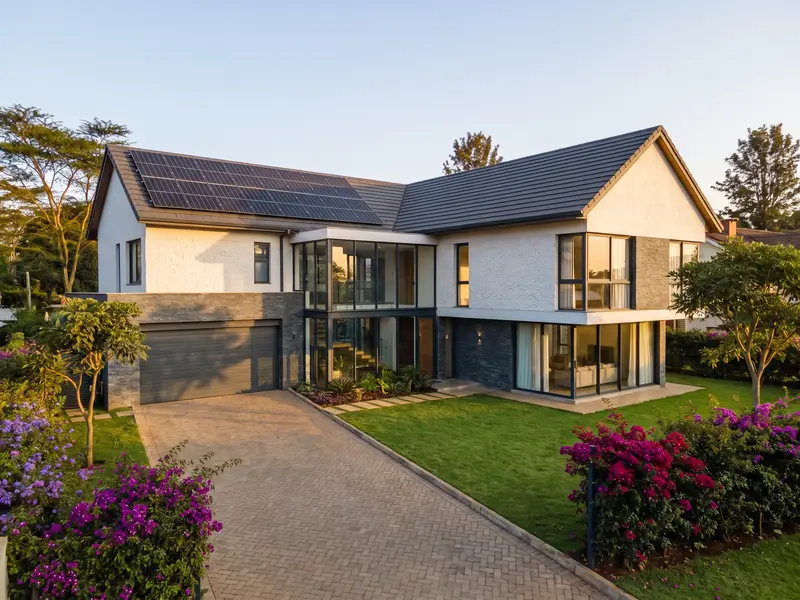
A home solar system is different. Fixed panels on the roof feed an inverter and a battery bank, wired into your house by a licensed installer. It costs more upfront but stores far more energy for the money and runs the whole house every day. A power station suits renters, short blackouts, a few key devices, and trips away from home.
Portable power station price in Kenya by size
Prices depend mainly on capacity and brand:
- Under 700Wh: typically about KSh 37,000, roughly KSh 17,000 to KSh 68,000.
- About 1kWh: typically about KSh 38,000 for lesser-known brands, rising to around KSh 100,000 or more for big names.
- 1.5kWh to 2kWh and above: typically about KSh 92,000, with large premium units well above KSh 200,000.
Brand makes the biggest difference at the same size. A 1kWh unit from a lesser-known brand can cost a third of an EcoFlow or Bluetti of similar capacity. Premium brands usually give faster charging, better apps, longer cycle ratings and a clearer warranty, but check each claim. For model-by-model figures, see our guides to EcoFlow prices in Kenya and Bluetti power stations.
Sizes in Wh and W: what each power station runs
Two numbers decide what a power station can do:
- Capacity (Wh) is how much energy it stores. Divide it by the load in watts, then take off about 15% for losses. A 1,000Wh unit runs a 100W load for roughly 8 to 9 hours.
- Output (W) is the most it can supply at once. A 600W unit cannot start a 1,500W kettle, however full it is.
Typical loads in a Kenyan home:
- LED bulbs: 5 to 10W each.
- WiFi router: about 10 to 15W. A 250Wh unit keeps it on for most of a day.
- Laptop: 45 to 65W while charging.
- 32 to 43 inch LED TV: about 30 to 80W.
- CPAP machine: often 30 to 60W, and much more with a heated humidifier. Check your machine's label.
- Small fridge: often around 1kWh a day, with a start-up surge of several times its running power.
As a rough guide, a 250Wh to 500Wh unit covers a router, phones, a laptop and a few lights. A 1kWh unit adds a TV and fan for an evening. A 2kWh unit can keep a small efficient fridge going for a day or so. If the fridge is the main reason you are buying, read about DC solar fridges first: they use far less power. The solar calculator helps you add up your own loads.
LiFePO4 or NMC, and charging from solar, KPLC or a car
Most current power stations use LiFePO4 (lithium iron phosphate) cells. They are typically rated for 3,000 cycles or more and are less prone to overheating. Some older models use NMC cells, which are lighter but are usually rated for far fewer cycles. If you plan to use the unit every day, choose LiFePO4.
You can charge a power station three ways:
- From KPLC. The fastest way. Premium units can go from empty to 80% in about an hour.
- From a solar panel. Check the maximum solar input in watts. A unit that accepts 200W will not charge faster with a 400W panel. On a clear Kenyan day, a panel gives roughly 4 to 5 times its rating in watt-hours, so a 200W panel puts back about 800Wh to 1,000Wh.
- From a car's 12V socket. Slow, often around 100W, but useful on a trip.
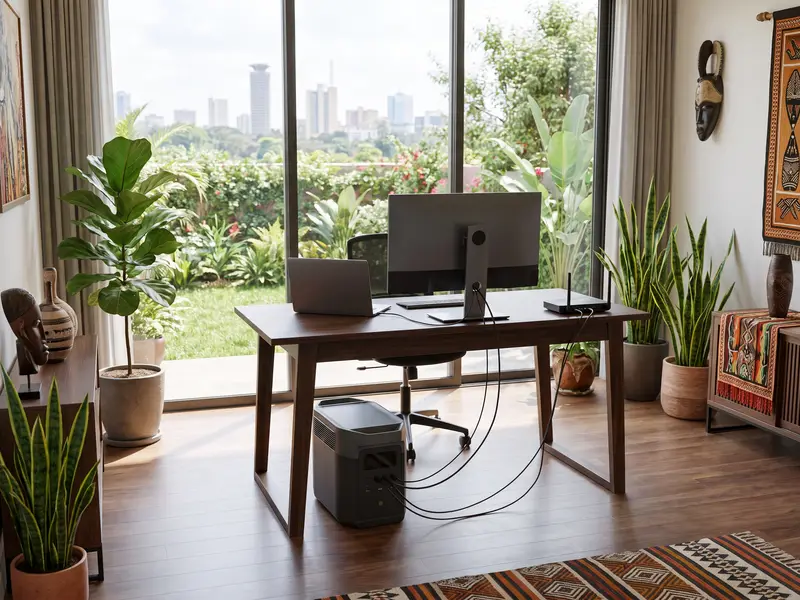
Most units also work as a basic UPS: plug the TV or router into it, plug it into the wall, and it takes over when KPLC goes off.
Power station brands in Kenya
EcoFlow sells the River series (small) and the Delta series (larger), known for fast charging and a good app. See EcoFlow models and prices.
Bluetti sells the small EB3A and AC50P, the mid-size AC70P and AC180P, and larger home backup units. It is often cheaper per watt-hour than EcoFlow. See our Bluetti buyer's guide.
Jackery is known for its Explorer range, with newer "Plus" models on LiFePO4. A Jackery portable power station is less common in Kenyan shops, so prices vary. Make sure you get a 230V version.
Anker Solix covers small units such as the C300 (288Wh, 300W), typically about KSh 40,000. Larger Anker units are priced well above EcoFlow and Bluetti of a similar size.
Hithium is a large maker of LiFePO4 battery cells and also sells power stations under its own name. Prices vary, so compare the Wh, W and warranty with the brands above.
Oraimo, best known in Kenya for phone chargers and power banks, also sells compact power stations. They suit phones, routers and laptops. Check the Wh rating, not just a mAh figure.
Lesser-known brands such as Vestwoods, Hinen, Marstek and Reomax sell 1kWh and 2kWh units for much less. Some are good value. Check the cell type, the real output and who handles repairs.
A portable power station for camping and travel
For camping, a safari or a shamba visit, weight matters as much as capacity. A 250Wh to 300Wh unit weighs about 3 to 4kg and runs lights, phones, a camera and a small fan. A 1kWh unit weighs around 10 to 12kg, which is manageable from a car but not on foot.
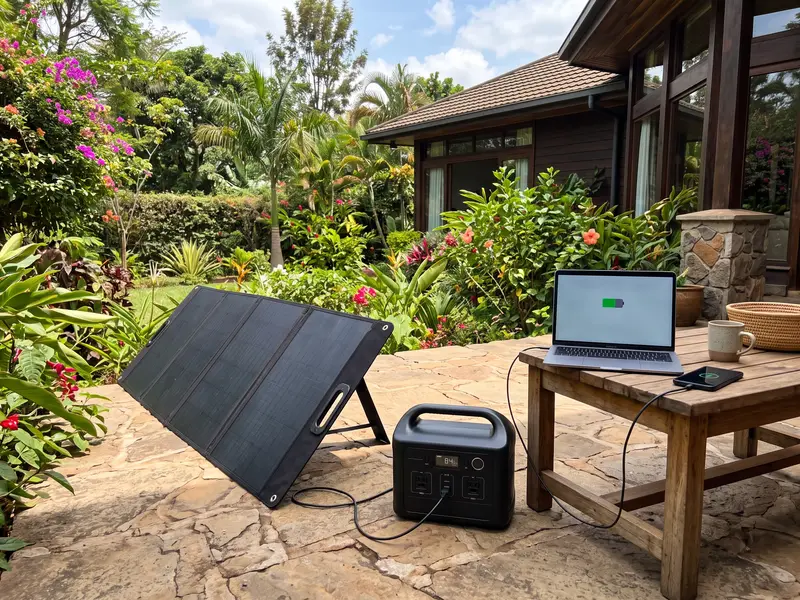
Pair it with a folding solar panel of 100W to 200W. Prop the panel at the sun and keep the power station itself in the shade, because batteries charge slower and age faster when hot. A car charging cable is a useful backup on cloudy days.
How to spot fake capacity claims
Cheap power stations and solar generators are often sold on inflated numbers. Before you pay:
- Look for Wh, not mAh. A mAh figure means little without the voltage. 30,000mAh at 3.7V is only about 111Wh.
- Check the weight. A real 1kWh LiFePO4 unit weighs around 10kg or more. A "1kWh" box that weighs 4kg is not 1kWh.
- Separate continuous and peak watts. A "2,000W" label may be a brief surge, with a continuous rating of half that.
- Test it. Run a known load, such as a 100W bulb or a TV, from full and time it. A 500Wh unit should manage about 4 hours at 100W.
- Avoid 110V to 120V versions. Units built for the US give 110V to 120V from the sockets, which will not run Kenyan 240V appliances properly. Ask for the UK or 230V version.
If you need more power every day than a power station gives, a fixed home solar system is the better buy. Send one request and up to 3 licensed installers will quote.