What it costs
| Size / type | Typical price | Range |
|---|---|---|
| PWM 10A | KSh 3,900 | 563 – 8,900 |
| unspecified 10A | KSh 1,500 | 1,300 – 2,848 |
| MPPT 15-20A | KSh 12,900 | 7,661 – 20,500 |
| PWM 15-20A | KSh 6,000 | 764 – 12,900 |
| unspecified 15-20A | KSh 1,999 | 1,262 – 14,040 |
| MPPT 30A | KSh 1,889 | 1,499 – 28,000 |
| PWM 30A | KSh 1,750 | 970 – 16,900 |
| unspecified 30A | KSh 2,750 | 699 – 21,600 |
| MPPT 40-50A | KSh 16,900 | 7,600 – 63,300 |
| PWM 40-50A | KSh 3,350 | 1,699 – 23,500 |
| unspecified 40-50A | KSh 7,000 | 5,700 – 8,300 |
| MPPT 60A | KSh 18,550 | 5,699 – 69,525 |
| PWM 60A | KSh 2,901 | 2,901 – 2,901 |
| unspecified 60A | KSh 32,500 | 10,500 – 71,460 |
| MPPT 70-100A | KSh 79,900 | 18,000 – 203,900 |
| unspecified 70-100A | KSh 4,499 | 2,545 – 80,820 |
Many cheap "MPPT" units, especially at 30A, are PWM controllers sold under the wrong name. Prices are approximate and vary by brand and seller.
What a solar charge controller does
Panels give a voltage that rises and falls with the sun. Connect them straight to a battery and you will over-charge it on a sunny day and let it drain back through the panels at night. The charge controller, also called a solar regulator or solar controller, sits between the panels and the battery and:
- charges the battery in stages (bulk, absorption, float) at the right voltages for its type;
- cuts the charge when the battery is full;
- disconnects the loads before the battery is drained too far (on models with a load output);
- blocks power flowing back to the panels at night.
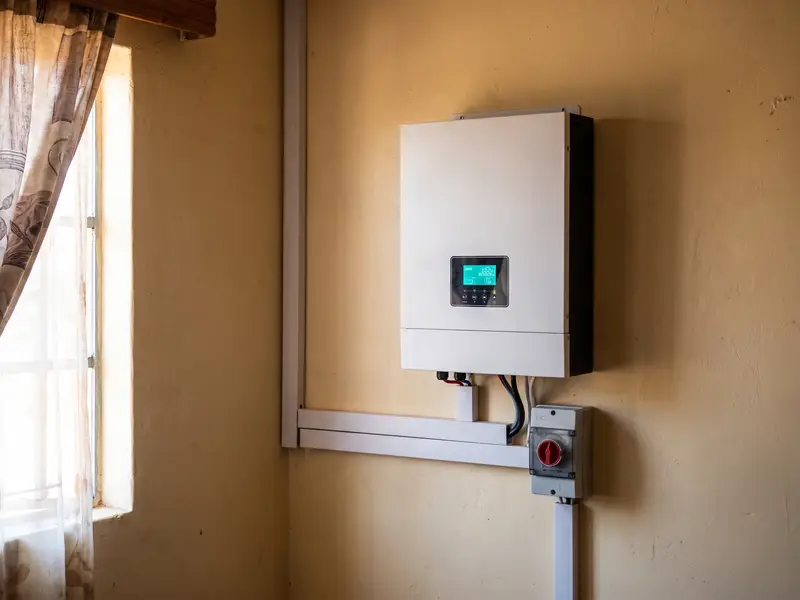
Most hybrid inverters have a solar inverter MPPT controller built in. You need a separate controller for DC-only systems, for a backup inverter without solar input, or to add more panels than the inverter can take.
MPPT vs PWM
- PWM controllers are simple and cheap. They pull the panel voltage down to the battery voltage, so a panel's extra voltage is wasted. They suit small systems where the panel's voltage is matched to the battery, such as a 12V panel on a 12V battery.
- MPPT controllers convert the panel's extra voltage into extra charging current. They usually harvest noticeably more energy, especially in cool weather, and let you wire panels in series at a higher voltage with thinner cables. They are the right choice for modern large panels, which run at voltages well above 12V.
If you use one of today's common 400W to 550W panels on a 12V or 24V battery, you need MPPT.
Cheap "MPPT" controllers are often PWM
30A controllers sold as MPPT typically cost about KSh 1,900, some as little as KSh 1,500. Real MPPT controllers from known brands start at about KSh 9,000 to 17,000, and premium brands such as Victron, Morningstar and Outback cost about KSh 20,000 to 170,000. A KSh 1,900 "MPPT" unit is almost certainly a PWM controller with the wrong label.
How to tell:
- Weight. A real MPPT controller has a heavy heat sink and inductor. Cheap PWM units are light plastic.
- Maximum input voltage. Real MPPT controllers accept a panel voltage well above the battery voltage (often 100V or more). A unit limited to about 50V for a 12V/24V battery is likely PWM.
- Price. If it costs the same as a PWM controller, it probably is one.
12V solar charge controller price in Kenya
Approximate prices:
- PWM 30A: typically about KSh 1,750
- Genuine MPPT 40 to 50A: typically about KSh 16,900
- MPPT 60A: typically about KSh 18,500
- MPPT 70 to 100A: typically about KSh 80,000, mostly premium brands
The full table is above. Most controllers work at 12V and 24V; larger ones also handle 48V.
Sizing, settings and how to connect a solar charge controller
Size: divide the panel watts by the battery voltage and add about 25%. For example, 400W of panels on a 12V battery gives about 33A, so use a 40A controller. Check that the panels' open-circuit voltage stays below the controller's maximum, even on a cold morning. See solar panel sizes for typical panel voltages.
Settings for a 12V battery: choose the battery type (flooded, sealed/AGM, gel or lithium) in the menu, or enter the voltages from the battery's datasheet. Lead-acid and lithium need different absorption and float voltages, and a wrong setting shortens battery life. See solar batteries.
Connecting: always connect the battery first, so the controller detects the system voltage, then the panels, then any loads. Disconnect in the reverse order. Put a fuse or DC breaker on the battery cable close to the battery. Our solar wiring diagram and solar cables and accessories pages show the parts and layout.