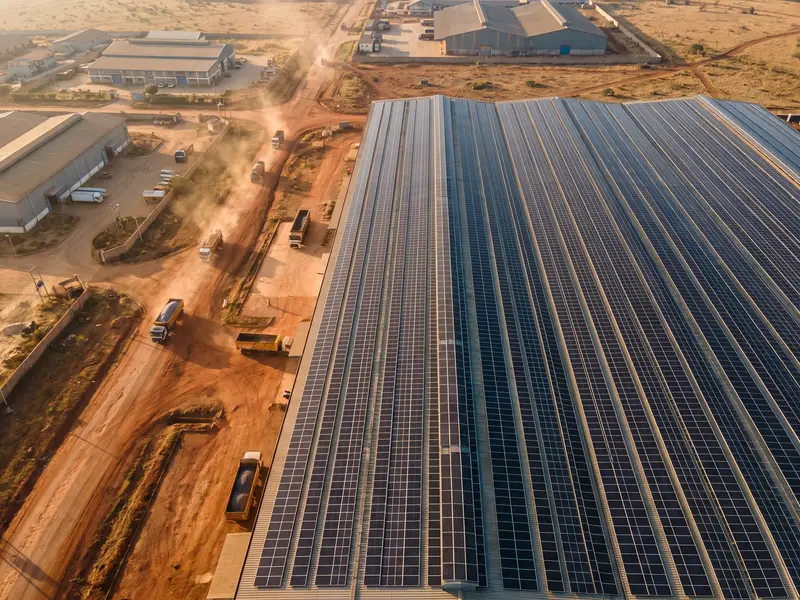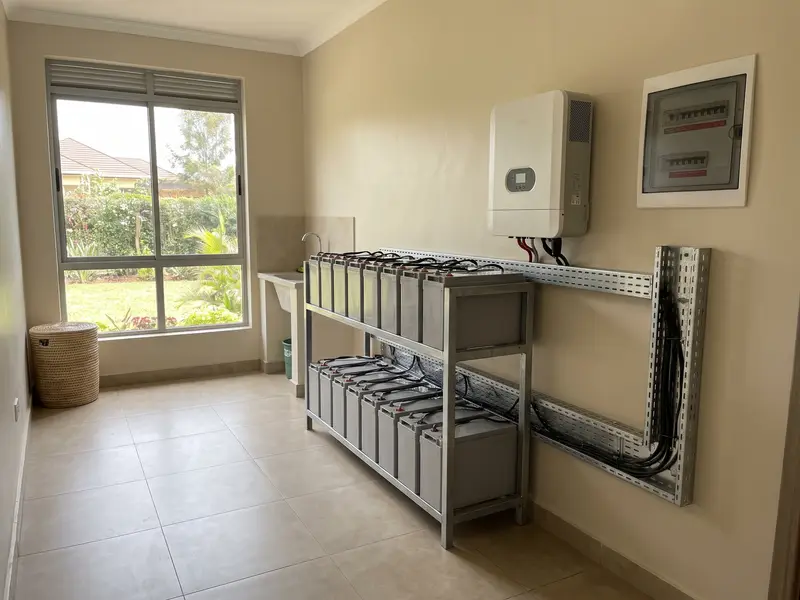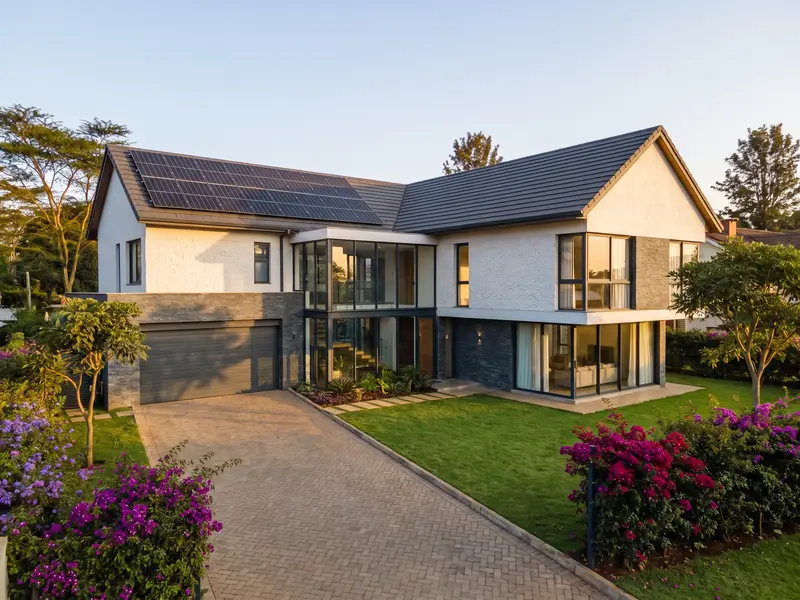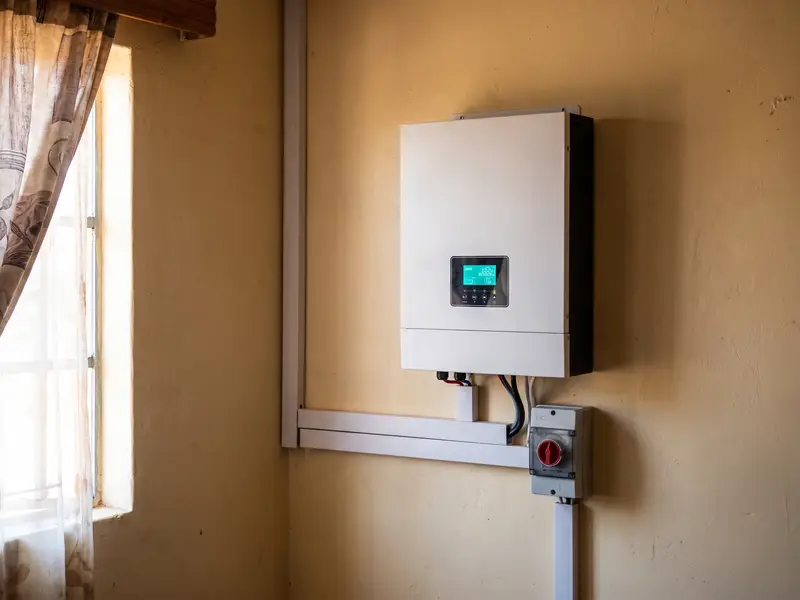
The basic diagram of a solar system
Power flows in one direction, from the sun to your sockets:
- Solar panels make DC electricity.
- DC isolator and fuses or a breaker let you switch the panels off and protect the cable.
- Charge controller (often inside a hybrid inverter) turns the panel output into a safe charging voltage.
- Battery bank stores energy, protected by a fuse or breaker close to the battery.
- Inverter turns battery DC into 240V AC.
- AC distribution board with breakers and an RCD feeds your sockets and lights.
- Earthing connects panel frames, mounting and the inverter to an earth rod.
In a small DC kit, the controller and battery are often in one box and the lights run straight from it, with no inverter. In a grid-tied or hybrid system, the inverter also connects to KPLC power.
Series or parallel: how to connect solar panels
Series means positive of one panel to negative of the next. The voltages add up and the current stays the same. Two panels of 40V and 10A in series give 80V at 10A.
Parallel means all positives together and all negatives together. The currents add up and the voltage stays the same. The same two panels in parallel give 40V at 20A.
- Choose series for MPPT controllers and hybrid inverters that accept high input voltage. Higher voltage means less current, thinner cable and lower losses over long runs.
- Choose parallel for PWM controllers, which need the panel voltage close to the battery voltage.
- Series-parallel combines both: strings of panels in series, then strings joined in parallel.
The key check: the open-circuit voltage (Voc) of a series string must stay below the controller's maximum PV input, with margin, because panel voltage rises on cool mornings. Only put panels with the same rating in one string.
Wiring the battery bank
Batteries follow the same rules. Two 12V 200Ah batteries in series give 24V 200Ah. In parallel they give 12V 400Ah.
- Use identical batteries of the same type, age and size in one bank. Mixing old and new shortens the life of all of them.
- In a parallel bank, take the main positive from one end and the main negative from the other end, so every battery charges equally.
- Keep the battery cables short and of equal length, and size them for the inverter's full current.
- Lithium batteries with a built-in battery management system may limit how many can be joined. Follow the maker's manual.
Our solar batteries guide explains which battery types suit which systems.
Fuses, breakers and safety
Solar DC is more dangerous than it looks. Panels make power whenever there is light, and a battery can deliver hundreds of amps into a short circuit, enough to melt cable and start a fire.
- Battery fuse: a fuse or DC breaker on the battery positive, as close to the battery as possible, rated for the cable.
- PV isolator: a DC isolator between panels and controller so the array can be switched off for work.
- String fuses: needed when three or more strings are joined in parallel.
- DC-rated parts only: AC breakers and switches are not built to break DC arcs.
- Surge protection on the PV and AC sides, especially in areas with lightning.
- Earthing of panel frames and mounting.
- Correct cable: solar cable rated for sunlight outdoors, sized for the current and the length of the run. See solar cables and accessories.
Many charge controller manuals say to connect the battery first, then the panels, and to disconnect in the reverse order. Check your own controller's manual. Cover the panels or switch off the isolator while you connect them.
Installing a solar system: do it yourself or hire a technician?
A small DC kit with plug-in lights is made for owners to set up. Anything with an inverter, a battery bank or a connection to your house wiring should be done by a trained technician. Kenya's solar regulations require solar PV installations to be done by an EPRA-licensed contractor, and a licensed installer should leave you a wiring diagram of your own system.
Read our guides on solar installation, charge controllers and solar inverters, or ask licensed installers for quotes.